


Certification Topics of AI-102 Exam PDF Recently Updated Questions
AI-102 Exam Prep Guide: Prep guide for the AI-102 Exam
Introduction to AI-102: Designing and Implementing an Azure AI Solution Exam
Candidates for AI-102 Exam are seeking to prove fundamental knowledge and skills in Designing and Implementing an Azure AI Solution domain. Before taking this exam, aspirants ought to have a solid fundamental information of the concepts shared in preparation guide as well as basic understanding of Azure administration, Azure development, and DevOpss would give an added edge.
This exam validates the ability to use the various services within the Microsoft Azure Artificial Intelligence (AI) portfolio.
It is suggested that professionals accustomed to the ideas and also the technologies represented here by taking relevant training courses. Candidates are expected to have some hands-on experience on bot services that use Language Understanding , bots with Azure Application Insights, creating a GPU, FPGA, or CPU-based solution, implementing AI workflow.
After passing this exam, candidates get a certificate from Microsoft that helps them to demonstrate their proficiency to their clients and employers.
NEW QUESTION # 109
You plan to deploy a containerized version of an Azure Cognitive Services service that will be used for text analysis.
You configurehttps://contoso.cognitiveservices.azure.comas the endpoint URI for the service, and you pull the latest version of the Text Analytics Sentiment Analysis container.
You need to run the container on an Azure virtual machine by using Docker.
How should you complete the command? To answer, select the appropriate options in the answer area.
NOTE:Each correct selection is worth one point.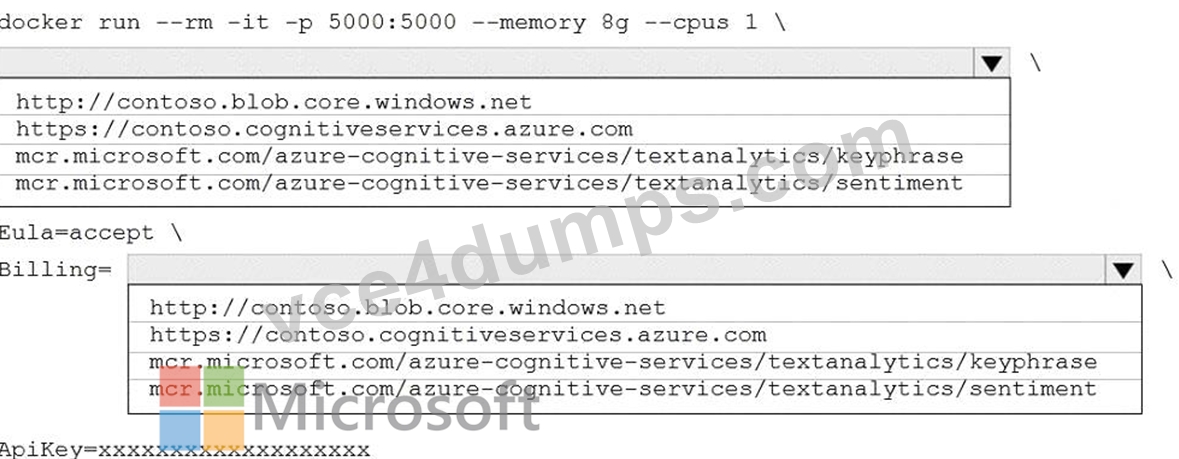
Answer:
Explanation: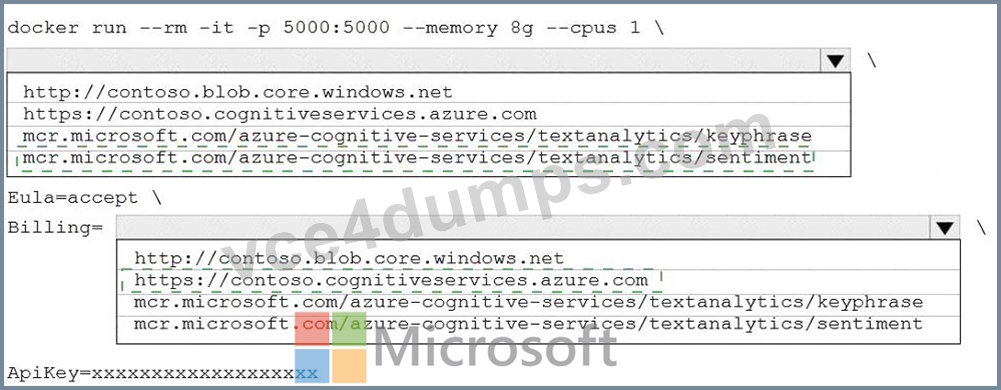
Explanation: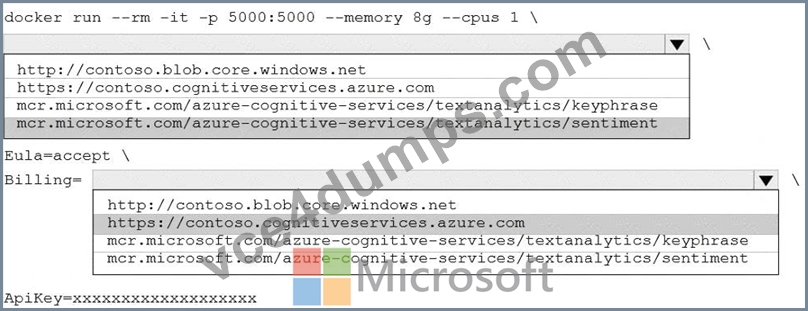
Box 1: mcr.microsoft.com/azure-cognitive-services/textanalytics/sentiment To run the Sentiment Analysis v3 container, execute the following docker run command.
docker run --rm -it -p 5000:5000 --memory 8g --cpus 1 \
mcr.microsoft.com/azure-cognitive-services/textanalytics/sentiment \
Eula=accept \
Billing={ENDPOINT_URI} \
ApiKey={API_KEY} is the endpoint for accessing the Text Analytics API.
https://<your-custom-subdomain>.cognitiveservices.azure.com
Box 2: https://contoso.cognitiveservices.azure.com
{ENDPOINT_URI} is the endpoint for accessing the Text Analytics API:
https://<your-custom-subdomain>.cognitiveservices.a The endpoint for accessing the Text Analytics API.
zure.com
Reference:
https://docs.microsoft.com/en-us/azure/cognitive-services/text-analytics/how-tos/text-analytics-how-to-install-co
NEW QUESTION # 110
You have a Custom Vision service project that performs object detection. The project uses the General domain for classification and contains a trained model.
You need to export the model for use on a network that is disconnected from the internet.
Which three actions should you perform in sequence? To answer, move the appropriate actions from the list o' actions to the answer area and arrange them in the correct order.
Answer:
Explanation:
Explanation
NEW QUESTION # 111
You have an app that manages feedback.
You need to ensure that the app can detect negative comments by using the Sentiment Analysis API in Azure Cognitive Service for Language. The solution must ensure that the managed feedback remains on your company's internal network.
Which three actions should you perform in sequence? To answer, move the appropriate actions from the list of actions to the answer area and arrange them in the correct order.
NOTE: More than one order of answer choices is correct You will receive credit for any of the correct orders you select.
Answer:
Explanation:
Explanation:
Provision the Language service resource in Azure.
Deploy a Docker container to an on-premises server.
Run the container and query the prediction endpoint.
According to the Microsoft documentation, the Language service is a cloud-based service that provides various natural language processing features, such as sentiment analysis, key phrase extraction, named entity recognition, etc. You can provision the Language service resource in Azure by following the steps in Create a Language resource. You will need to provide a name, a subscription, a resource group, a region, and a pricing tier for your resource. You will also get a key and an endpoint for your resource, which you will use to authenticate your requests to the Language service API.
According to the Microsoft documentation, you can also use the Language service as a container on your own premises or in another cloud. This option gives you more control over your data and network, and allows you to use the Language service without an internet connection. You can deploy a Docker container to an on- premises server by following the steps in Deploy Language containers. You will need to have Docker installed on your server, pull the container image from the Microsoft Container Registry, and run the container with the appropriate parameters. You will also need to activate your container with your key and endpoint from your Azure resource.
According
to the Microsoft documentation, once you have deployed and activated your container, you can run it and query the prediction endpoint to get sentiment analysis results. The prediction endpoint is a local URL that follows this format: http://
<container IP address>:<port>/text/analytics/v3.1-preview.4/sentiment. You can send HTTP POST requests to this endpoint with your text input in JSON format, and receive JSON responses with sentiment labels and scores for each document and sentence in your input.
NEW QUESTION # 112
You are building an Azure Cognitive Search custom skill.
You have the following custom skill schema definition.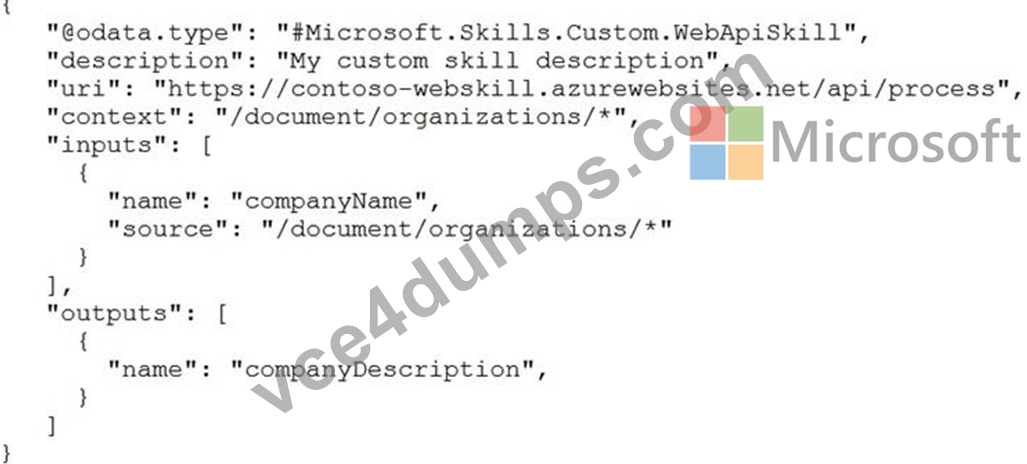
For each of the following statements, select Yes if the statement. Otherwise, select No.
NOTE: Each correct selection is worth one point.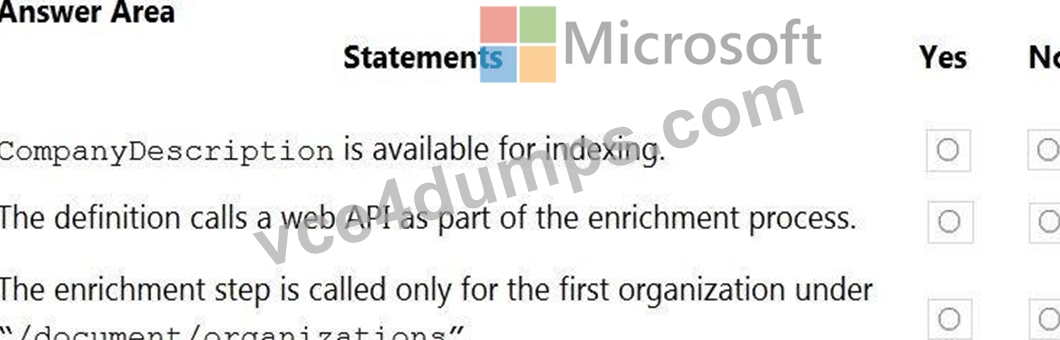
Answer:
Explanation: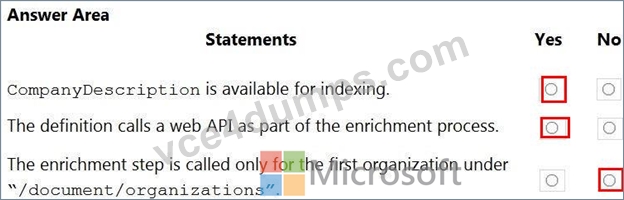
Reference:
https://docs.microsoft.com/en-us/azure/search/cognitive-search-output-field-mapping
NEW QUESTION # 113
You have an Azure subscription. The subscription contains an Azure OpenAI resource that hosts a GPT-3.5 Turbo model named Model1.
You configure Model1 to use the following system message: "You are an Al assistant that helps people solve mathematical puzzles. Explain your answers as if the request is by a 4-year-old." Which type of prompt engineering technique is this an example of?
- A. chain of thought
- B. few-shot learning
- C. priming
- D. affordance
Answer: C
Explanation:
The system message you provided-"You are an AI assistant that helps people solve mathematical puzzles.
Explain your answers as if the request is by a 4-year-old."-is classic priming (also called system prompt/role prompting). Priming sets the assistant's persona, objectives, tone, and constraints before any user message, steering all subsequent responses accordingly.
Why the other options are incorrect:
* A. Few-shot learning - supplies example Q&A pairs in the prompt to teach the model by example; none were included here.
* B. Affordance - relates to interface cues that guide users; not a prompt technique for model behavior.
* C. Chain of thought - asks the model to show intermediate reasoning steps; your prompt doesn't request step-by-step rationale, only a style/tone.
Microsoft Azure AI References
* Azure OpenAI - Prompt engineering techniques (role/system prompts, priming).
* Azure OpenAI - System message (role) guidance for controlling assistant behavior and tone.
NEW QUESTION # 114
You have the following C# method.
You need to deploy an Azure resource to the East US Azure region. The resource will be used to perform sentiment analysis.
How should you call the method?
- A. create_resource("res1", "ContentModerator", "S0", "eastus")
- B. create_resource("res1", "TextAnalytics", "S0", "eastus")
- C. create_resource("res1", "ContentModerator", "Standard", "East US")
- D. create_resource("res1", "TextAnalytics", "Standard", "East US")
Answer: B
Explanation:
Explanation
To perform sentiment analysis, we specify TextAnalytics, not ContentModerator.
Possible SKU names include: 'F0','F1','S0','S1','S2','S3','S4','S5','S6','S7','S8' Possible location names include: westus, eastus Reference:
https://docs.microsoft.com/en-us/powershell/module/az.cognitiveservices/new-azcognitiveservicesaccount
NEW QUESTION # 115
You are building an agent by using the Azure Al Foundry Agent Service.
You have the following code.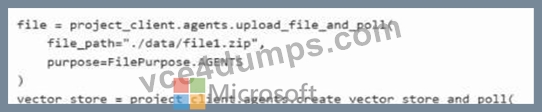
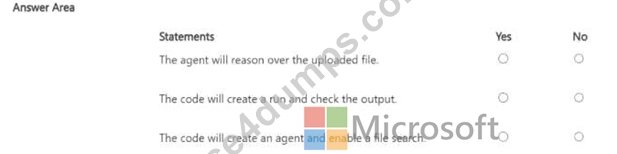
Answer:
Explanation: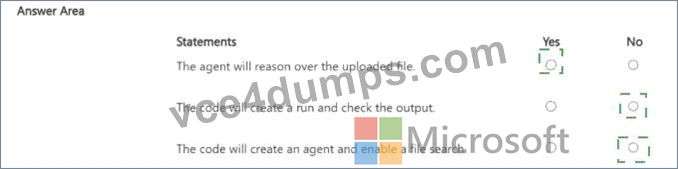
Explanation:
The agent will reason over the uploaded file.##
The code will create a run and check the output.##
The code will create an agent and enable a file search.##
The agent will reason over the uploaded file.
* Yes: The code includes file = project_client.agents.upload_file_and_poll(file_path="./data/file1.zip", purpose=FilePurpose.AGENTS). The upload_file_and_poll method with FilePurpose.AGENTS suggests that the file (file1.zip) is uploaded for the agent to process, and agents in the Azure AI Foundry Agent Service are typically designed to reason over uploaded data. This indicates the agent will reason over the uploaded file.
The code will create a run and check the output.
* No: The provided code snippet does not include any explicit call to create a run (e.g., a method like create_run or start_run) or check the output (e.g., a method to retrieve or poll run results). The code only uploads a file and creates a vector store, but it does not initiate or monitor a run.
The code will create an agent and enable a file search.
* No: The code does not contain a method to create an agent (e.g., create_agent) or explicitly enable a file search. The create_vector_store_and_poll method creates a vector store, which is typically used for indexing data for search, but there is no indication of enabling a file search or creating an agent in this snippet.
NEW QUESTION # 116
Hotspot Question
You are building an app that will perform speech translation by using the Azure AI Language service.
You need to ensure that the language input to the app is supported.
How should you complete the code? To answer, select the appropriate options in the answer area.
NOTE: Each correct selection is worth one point.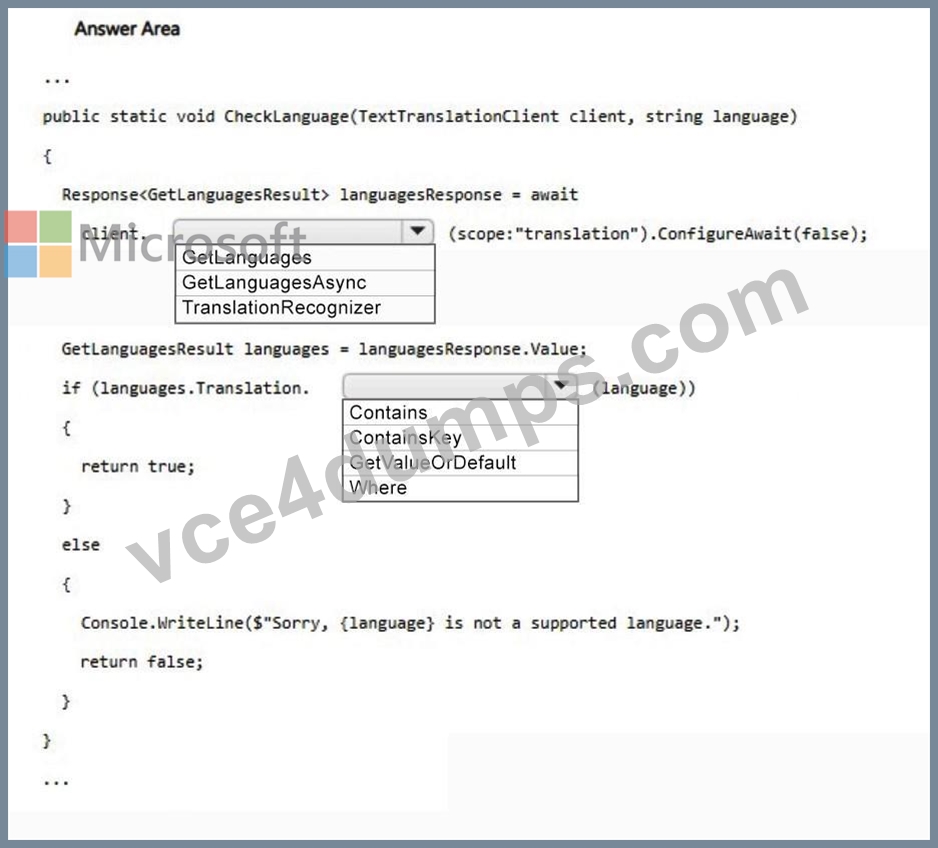
Answer:
Explanation: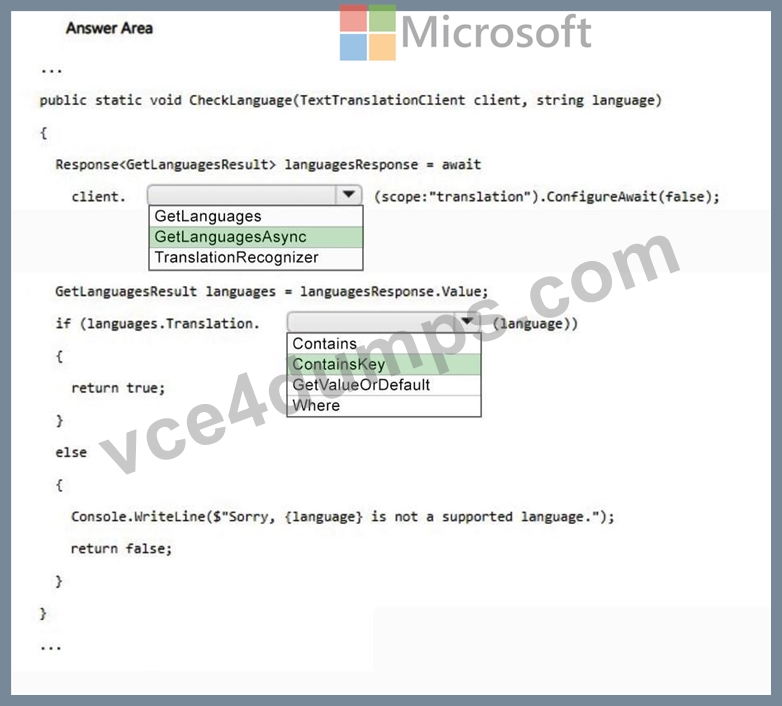
NEW QUESTION # 117
You need to create a new resource that will be used to perform sentiment analysis and optical character recognition (OCR). The solution must meet the following requirements:
Use a single key and endpoint to access multiple services.
Consolidate billing for future services that you might use.
Support the use of Computer Vision in the future.
How should you complete the HTTP request to create the new resource? To answer, select the appropriate options in the answer area.
NOTE: Each correct selection is worth one point.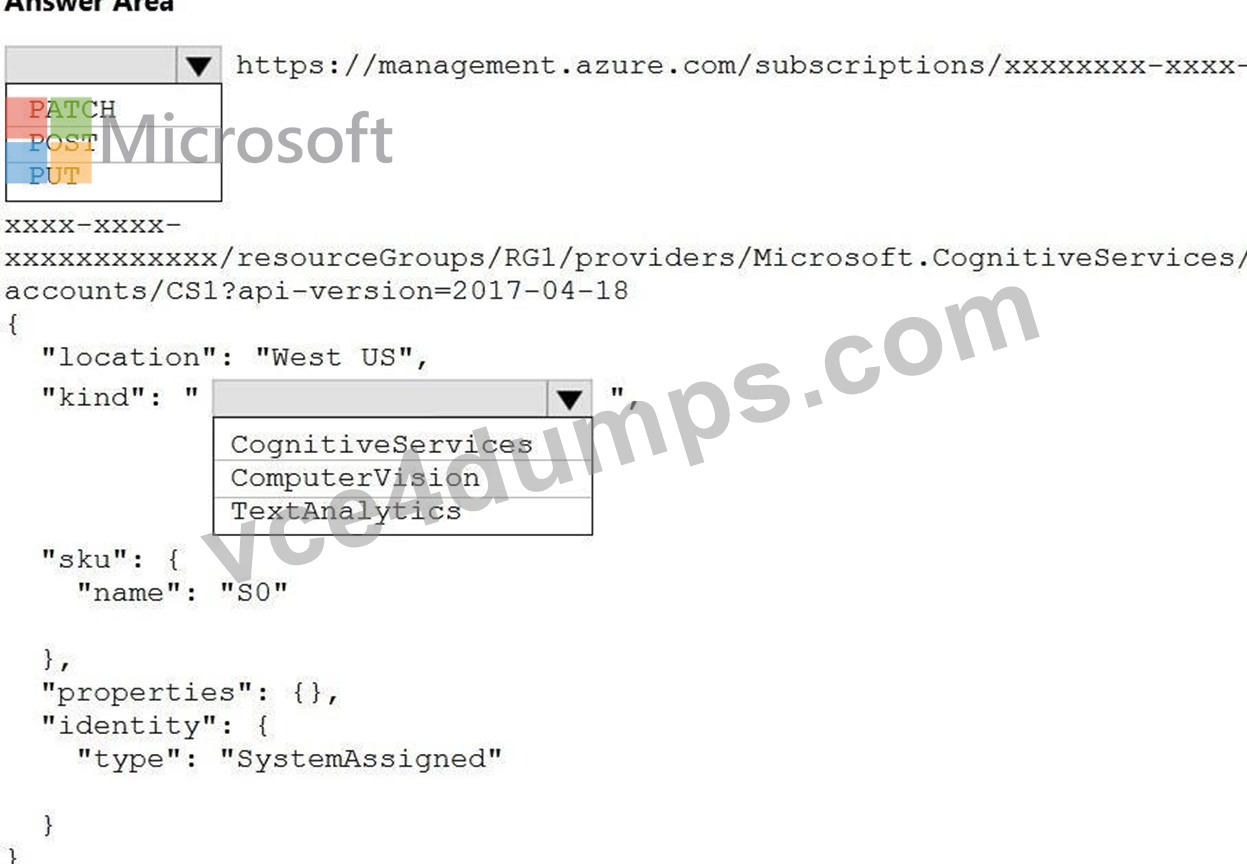
Answer:
Explanation: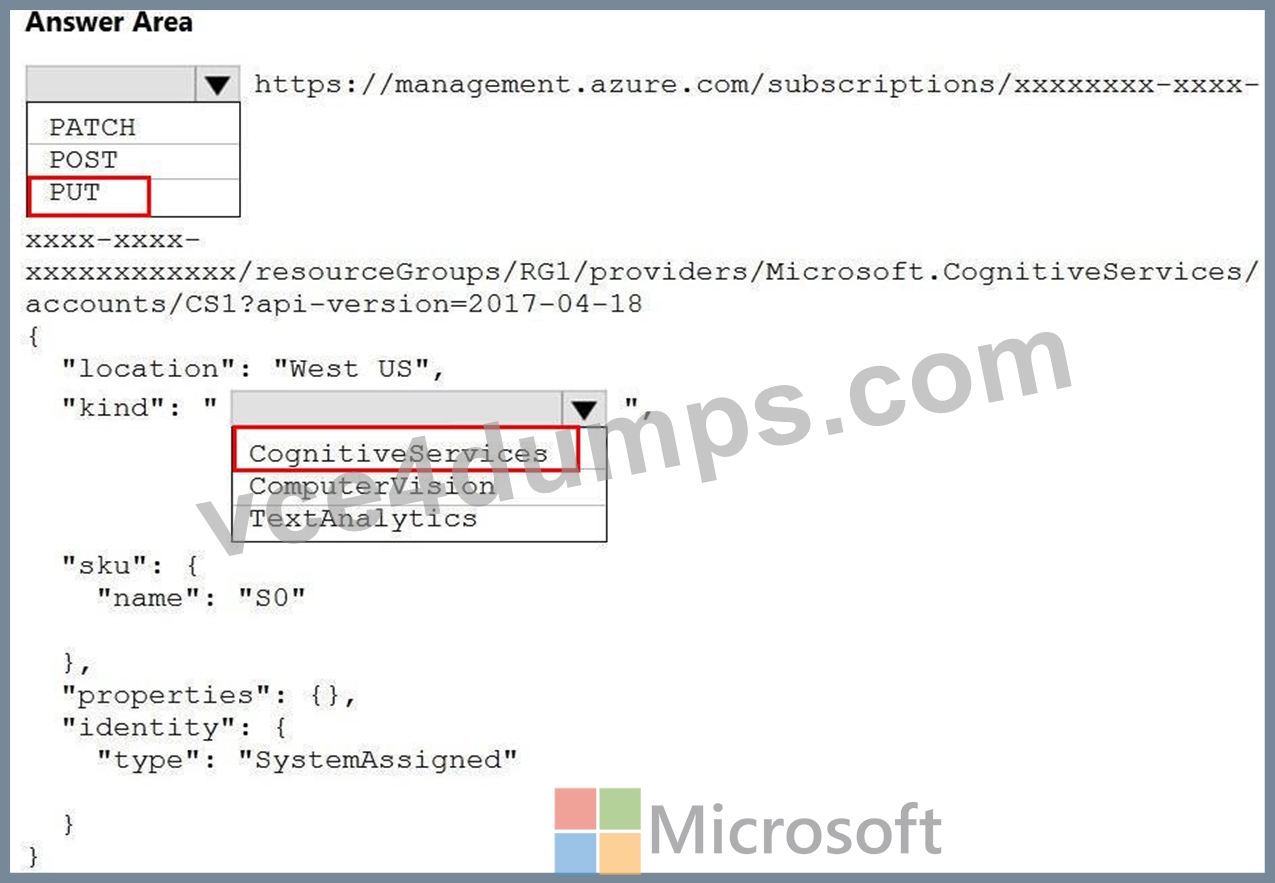
Reference:
https://docs.microsoft.com/en-us/rest/api/deviceupdate/resourcemanager/accounts/create
https://www.analyticsvidhya.com/blog/2020/12/microsoft-azure-cognitive-services-api-for-ai-development/
NEW QUESTION # 118
You have an Azure subscription that contains an Azure Al Content Safety resource named CS1.
You need to call CS1 to identify whether a user request contains hateful language.
How should you complete the command? To answer, select the appropriate options in the answer area NOTE: Each correct selection is worth one point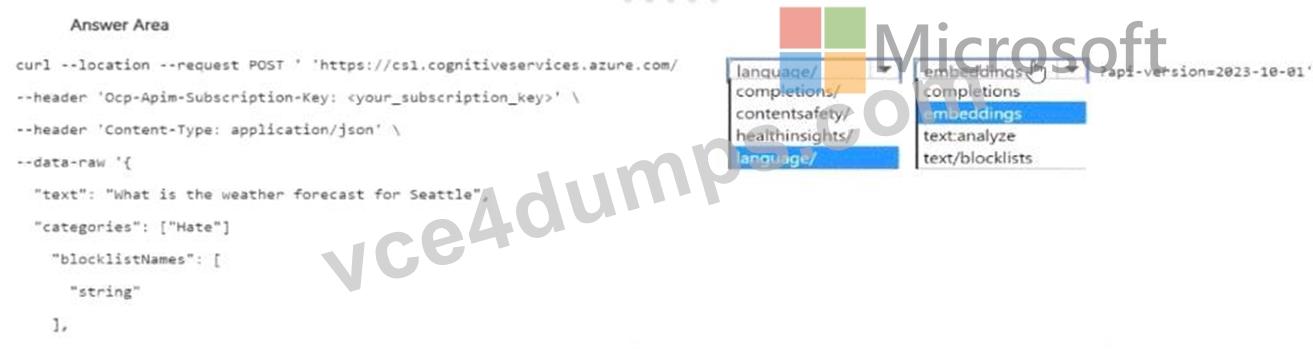
Answer:
Explanation: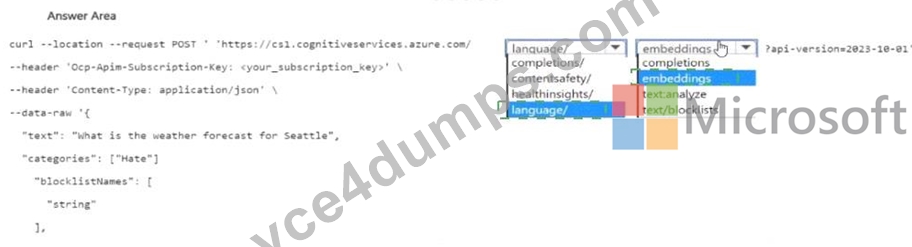
Explanation: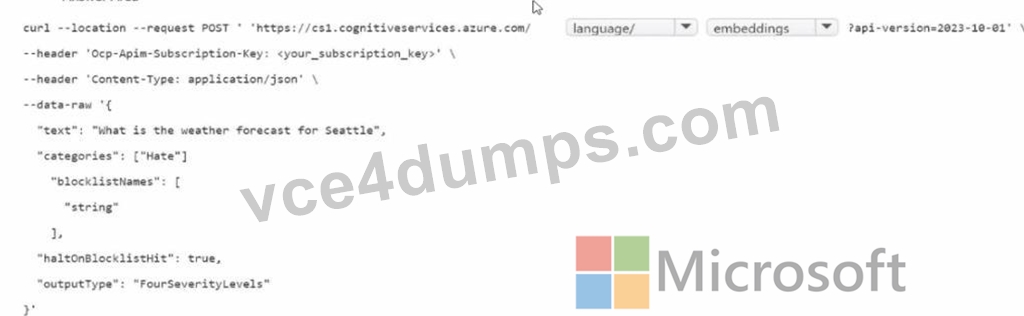
NEW QUESTION # 119
Case Study 2 - Contoso, Ltd.
General Overview
Contoso, Ltd. is an international accounting company that has offices in France. Portugal, and the United Kingdom. Contoso has a professional services department that contains the roles shown in the following table.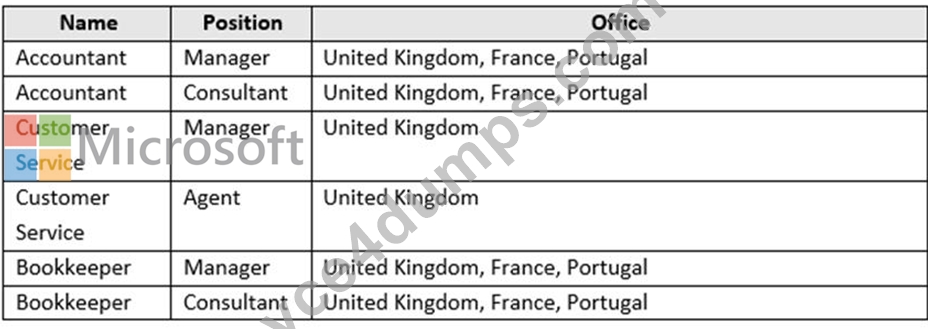
Infrastructure
Contoso has the following subscriptions:
- Azure
- Microsoft 365
- Microsoft Dynamics 365
Azure Active (Azure AD) Directory
Contoso has Azure Active Directory groups for securing role-based access. The company uses the following group naming conventions:
- ICountryJ-[Levell-[Role]
- [Level]-[Role]
Intellectual Property
Contoso has the intellectual property shown in the following table.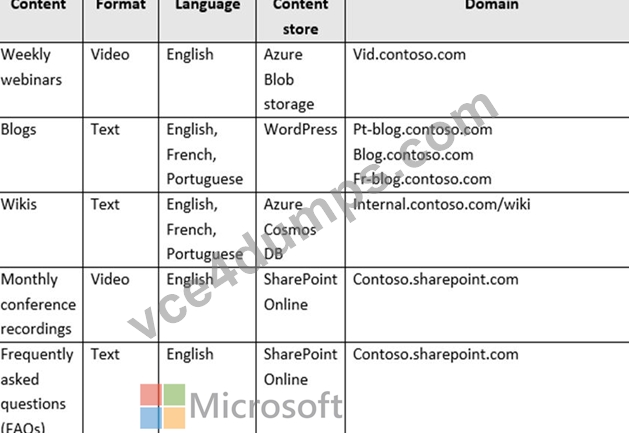
Text-based content is provided only in one language and is not translated.
Planned Projects
Contoso plans to develop the following:
- A document processing workflow to extract information automatically from PDFs and images of financial documents
- A customer-support chatbot that will answer questions by using FAQs
- A searchable knowledgebase of all the intellectual property
Technical Requirements
Contoso identifies the following technical requirements:
- All content must be approved before being published.
- All planned projects must support English, French, and Portuguese.
- All content must be secured by using role-based access control (RBAC).
- RBAC role assignments must use the principle of least privilege.
- RBAC roles must be assigned only to Azure Active Directory groups.
- Al solution responses must have a confidence score that is equal to or greater than 70 percent.
- When the response confidence score of an Al response is lower than 70 percent, the response must be improved by human input.
Chatbot Requirements
Contoso identifies the following requirements for the chatbot:
- Provide customers with answers to the FAQs.
- Ensure that the customers can chat to a customer service agent.
- Ensure that the members of a group named Management-Accountants can approve the FAQs.
- Ensure that the members of a group named Consultant-Accountants can create and amend the FAQs.
- Ensure that the members of a group named the Agent-CustomerServices can browse the FAQs.
- Ensure that access to the customer service agents is managed by using Omnichannel for Customer Service.
- When the response confidence score is low.
- Ensure that the chatbot can provide other response options to the customers.
Document Processing Requirements
Contoso identifies the following requirements for document processing:
- The document processing solution must be able to process standardized financial documents that have the following characteristics:
- Contain fewer than 20 pages.
- Be formatted as PDF or JPEG files.
- Have a distinct standard for each office.
- The document processing solution must be able to extract tables and text from the financial documents.
- The document processing solution must be able to extract information from receipt images.
- Members of a group named Management-Bookkeeper must define how to extract tables from the financial documents.
- Members of a group named Consultant-Bookkeeper must be able to process the financial documents.
Knowledgebase Requirements
Contoso identifies the following requirements for the knowledgebase:
- Supports searches for equivalent terms
- Can transcribe jargon with high accuracy
- Can search content in different formats, including video
- Provides relevant links to external resources for further research
You are developing the chatbot.
You create the following components:
- A QnA Maker resource
- A chatbot by using the Azure Bot Framework SDK.
You need to integrate the components to meet the chatbot requirements.
Which property should you use?
- A. Qna MakerOptions StrickFilters
- B. Qna MakerOptions-ScoreThreshold
- C. QnADialogResponseOptions.CardNoMatchText
- D. QnaMakerOptions.RankerType
Answer: B
Explanation:
Technical Requirements says "AI solution responses must have a confidence score that is equal to or greater than 70 percent" and "When the response confidence score is low, ensure that the chatbot can provide other response options to the customers".
Reference:
https://docs.microsoft.com/en-us/azure/cognitive-services/qnamaker/concepts/confidence- score#set-threshold
NEW QUESTION # 120
You have an Azure OpenAl resource named Al1 that hosts three deployments of the GPT 3.5 model. Each deployment is optimized for a unique workload.
You plan to deploy three apps. Each app will access Al1 by using the REST API and will use the deployment that was optimized for the app's intended workload.
You need to provide each app with access to Al1 and the appropriate deployment. The solution must ensure that only the apps can access Al1.
What should you use to provide access to Al1, and what should each app use to connect to its appropriate deployment? To answer, select the appropriate options in the answer area.
NOTE: Each correct selection is worth one point.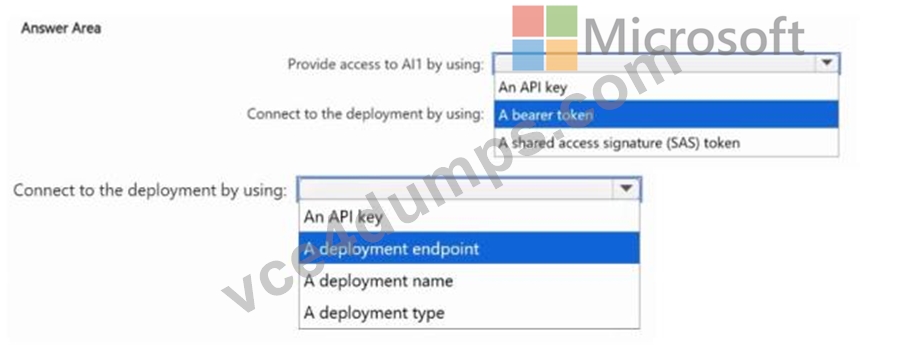
Answer:
Explanation: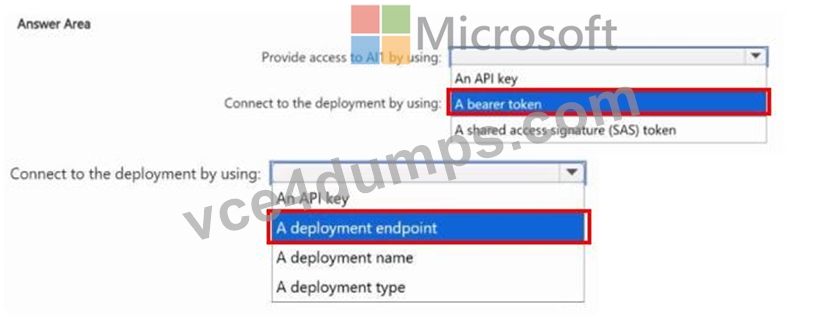
NEW QUESTION # 121
You are building a chatbot by using the Microsoft Bot Framework Composer.
You have the dialog design shown in the following exhibit.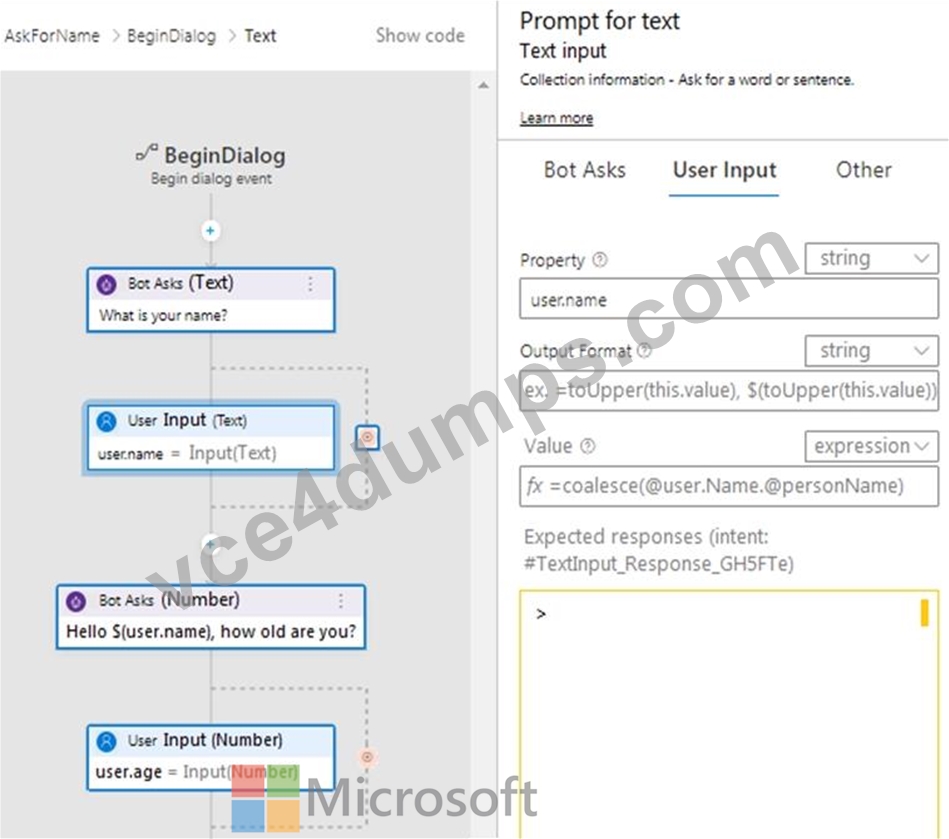
For each of the following statements, select Yes if the statement is true. Otherwise, select No.
NOTE: Each correct selection is worth one point.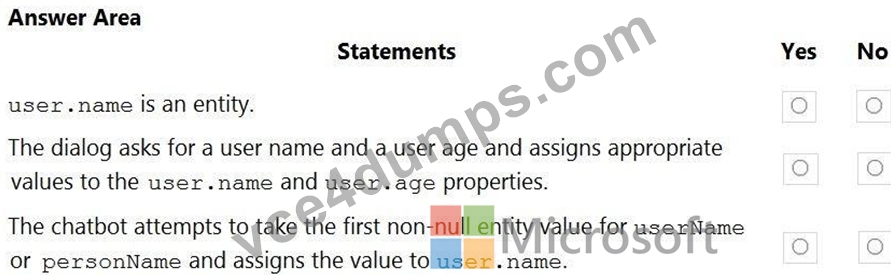
Answer:
Explanation: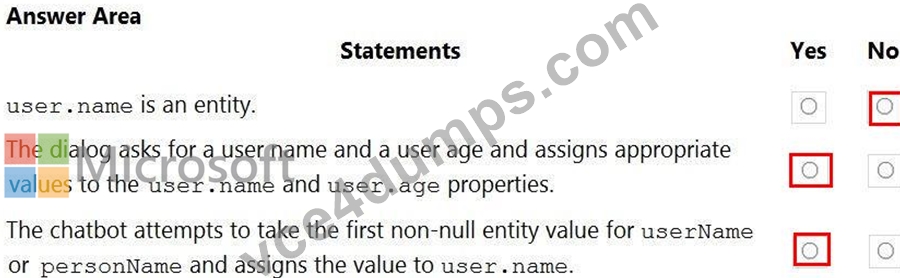
Reference:
https://docs.microsoft.com/en-us/composer/concept-language-generation
https://docs.microsoft.com/en-us/azure/data-explorer/kusto/query/coalescefunction
NEW QUESTION # 122
You are developing a text processing solution.
You have the following function.
static void GotKeyWords(TextAnalyticsClient textAnalyticsClient, string text) var response = textAnalyticsClient.RecognizeEntities (text); Console.WriteLine("Key words:"); foreach (CategorizedEntity entity in response.Value) Console.WriteLine($"\t{entity.Text}"); You call the function and use the following string as the second argument.
Our tour of London included a visit to Buckinghan Palace
What will the function return?
- A. London and Tour only
- B. Our tour of London included a visit to Buckingham Palace
- C. Tour and visit only
- D. London and Buckinghan Palace only
Answer: D
Explanation:
The function GotKeyWords uses the RecognizeEntities method from the TextAnalyticsClient class in Azure's Text Analytics service to identify named entities in the given text. The method extracts entities such as locations, organizations, dates, and other significant items.
Given the string "Our tour of London included a visit to Buckinghan Palace", the RecognizeEntities method will identify named entities within the text.
The named entities in this text are:
* London (a location)
* Buckingham Palace (a location, but note the typo "Buckinghan Palace" instead of "Buckingham Palace") However, the typo in "Buckinghan Palace" might prevent the service from recognizing it correctly. Assuming the typo is fixed, the recognized entities would be "London" and "Buckingham Palace".
NEW QUESTION # 123
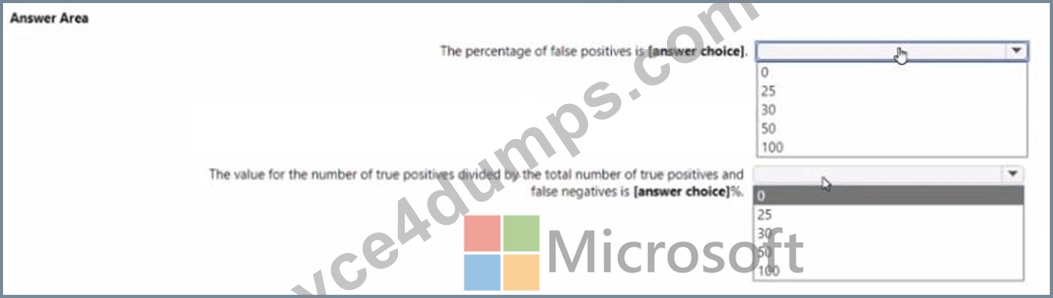
You are building a model to detect objects in images.
The performance of the model based on training data is shown in the following exhibit.
Answer:
Explanation: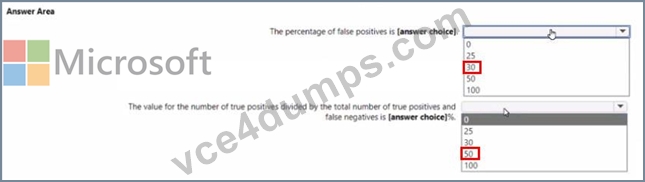
NEW QUESTION # 124
You develop an app in O named App1 that performs speech-to-speech translation.
You need to configure App1 to translate English to German.
How should you complete the speechTransiationConf ig object? To answer, drag the appropriate values to the correct targets. Each value may be used once, more than once, or not at all. You may need to drag the split bar between panes or scroll to view content.
NOTE: Each correct selection is worth one point.
Answer:
Explanation:
NEW QUESTION # 125
You are building a social media extension that will convert text to speech. The solution must meet the following requirements:
* Support messages of up to 400 characters.
* Provide users with multiple voice options.
* Minimize costs.
You create an Azure Cognitive Services resource.
Which Speech API endpoint provides users with the available voice options?
- A. https://uksouth.api.cognitive.microsoft.eom/speechtotext/v3.0/models/base
- B. https://uksouth.customvoice.apispeech.microsoft.eom/api/texttospeech/v3.0/longaudiosynthesis/voices
- C. https://uksouth.tts.speech.microsoft.conT/cognitiveservices/voices/list
- D. https://uksouth.voice.speech.microsoft.com/cognitiveservices/v1?deploymentld = {deploymentld>
Answer: D
NEW QUESTION # 126
You have a monitoring solution that uses the Azure Al Anomaly Detector service.
You provision a server named Server! that has intermittent internet access.
You need to deploy the Azure Al Anomaly Detector to Server 1.
Which four actions should you perform in sequence? To answer, move the appropriate actions from the list of actions to the answer area and arrange them in the correct order.
Answer:
Explanation:
Explanation:
NEW QUESTION # 127
You are building an app by using the Semantic Kernel.
You need to include complex objects in the prompt templates of the app. The solution must support objects that contain subproperties.
Which two prompt templates can you use? Each correct answer presents a complete solution.
NOTE: Each correct selection is worth one point.
- A. Handlebars
- B. YAML
- C. JSONL
- D. Semantic Kernel
- E. Liquid
Answer: A,E
Explanation:
Semantic Kernel provides support for the following template formats:
semantic-kernel - Built-in Semantic Kernel format.
handlebars - Handlebars template format.
liquid - Liquid template format
The Semantic Kernel prompt template language is a simple way to define and compose AI functions using plain text. You can use it to create natural language prompts, generate responses, extract information, invoke other prompts or perform any other task that can be expressed with text.
Reference:
https://learn.microsoft.com/en-us/semantic-kernel/concepts/prompts/prompt-template-syntax
NEW QUESTION # 128
You have an Azure subscription. The subscription contains an Azure OpenAI resource that hosts a GPT-3.5 Turbo model named Model1.
You configure Model1 to use the following system message: "You are an AI assistant that helps people solve mathematical puzzles. Explain your answers as if the request is by a 4-year-old." Which type of prompt engineering technique is this an example of?
- A. chain of thought
- B. few-shot learning
- C. priming
- D. affordance
Answer: C
NEW QUESTION # 129
......
2026 New Preparation Guide of Microsoft AI-102 Exam: https://examtorrent.vce4dumps.com/AI-102-latest-dumps.html