


Get The Most Updated Introduction-to-Biology Dumps To Courses and Certificates Certification
WGU Certified Introduction-to-Biology Dumps Questions Valid Introduction-to-Biology Materials
NEW QUESTION # 47
Cells use ATP to power muscle contraction. During contraction, ATP is converted to ADP and inorganic phosphate. What is happening to energy in this conversion?
- A. Energy is being created.
- B. Energy is being released.
- C. Energy is being stored.
- D. Energy is being destroyed.
Answer: B
NEW QUESTION # 48
Transcription of RNA from DNA occurs in whicheukaryotic organelle?
- A. Nucleus
- B. Chloroplast
- C. Endoplasmic reticulum
- D. Golgi apparatus
Answer: A
NEW QUESTION # 49
A farmer breeds sheep fordisease resistanceandfine wool. After decades, the flock consistently shows both traits. Which evolutionary mechanism changed the flock's gene pool?
- A. Natural selection
- B. Gene flow
- C. Artificial selection
- D. Sexual selection
Answer: C
NEW QUESTION # 50
A wildlife biologist studies how lions and zebras interactandhow physical factors (temperature, water) affect them in the Serengeti. Which level of ecological organization is being studied?
- A. Population
- B. Biosphere
- C. Ecosystem
- D. Community
Answer: C
NEW QUESTION # 51
Which statement correctly describes the flow of information duringgene expression?
- A. RNA is formed from DNA, then protein is formed from RNA
- B. RNA is formed from protein, then DNA is formed from RNA
- C. DNA is formed from RNA, then protein is formed from DNA
- D. DNA is formed from protein, then RNA is formed from DNA
Answer: A
NEW QUESTION # 52
What is a primary characteristic ofperipheral membrane proteins?
- A. Weak intermolecular forces keep them attached to the lipid membrane.
- B. They cannot be post-translationally modified.
- C. They span the entire lipid bilayer, sometimes multiple times.
- D. Detergents or nonpolar solvents are necessary to remove them from the membrane.
Answer: A
NEW QUESTION # 53
During whichphase of mitosisare the replicated chromosomessplitand the daughter chromosomesmoved to opposite poles?
- A. Metaphase
- B. Prophase
- C. Telophase
- D. Anaphase
Answer: D
NEW QUESTION # 54
A molecule doesnotdissolve in water and consists ofglycerol covalently bound to three fatty acid tails.
What is the primary function of this molecule?
- A. Catalysis of chemical reactions
- B. Energy storage
- C. Cell communication
- D. Genetic information storage
Answer: B
NEW QUESTION # 55
Ocean acidification dissolves calcium-based exoskeletons of purple sea urchins. Some individuals have a trait making their exterior more acid-resistant. If acidification increases, how is this population most likely to evolve?
- A. Less acid-resistant exoskeletons become more common
- B. Shorter, more flexible spines become more common
- C. Acid-resistant exoskeletons become more common
- D. Longer, more rigid spines become more common
Answer: C
NEW QUESTION # 56
Which molecule isproducedby photosynthesis?
- A. Water
- B. Carbon dioxide
- C. Oxygen
- D. NADH
Answer: C
NEW QUESTION # 57
What plays multiple roles in the nitrogen cycle, including converting nitrogen gas into a plant-usable form?
- A. Lightning
- B. Bacteria
- C. Fungi
- D. Animals
Answer: B
NEW QUESTION # 58
What is the correctorderof the major events inDNA replication?
- A. Unwinding the DNA # synthesis of a complementary strand # joining the two DNA strands
- B. Unwinding the DNA # joining the two DNA strands # synthesis of a complementary strand
- C. Joining the two DNA strands # synthesis of a complementary strand # unwinding the DNA
- D. Synthesis of a complementary strand # unwinding the DNA # joining the two DNA strands
Answer: A
NEW QUESTION # 59
Which organisms havefour limbsand produceeggs that are not amniotic?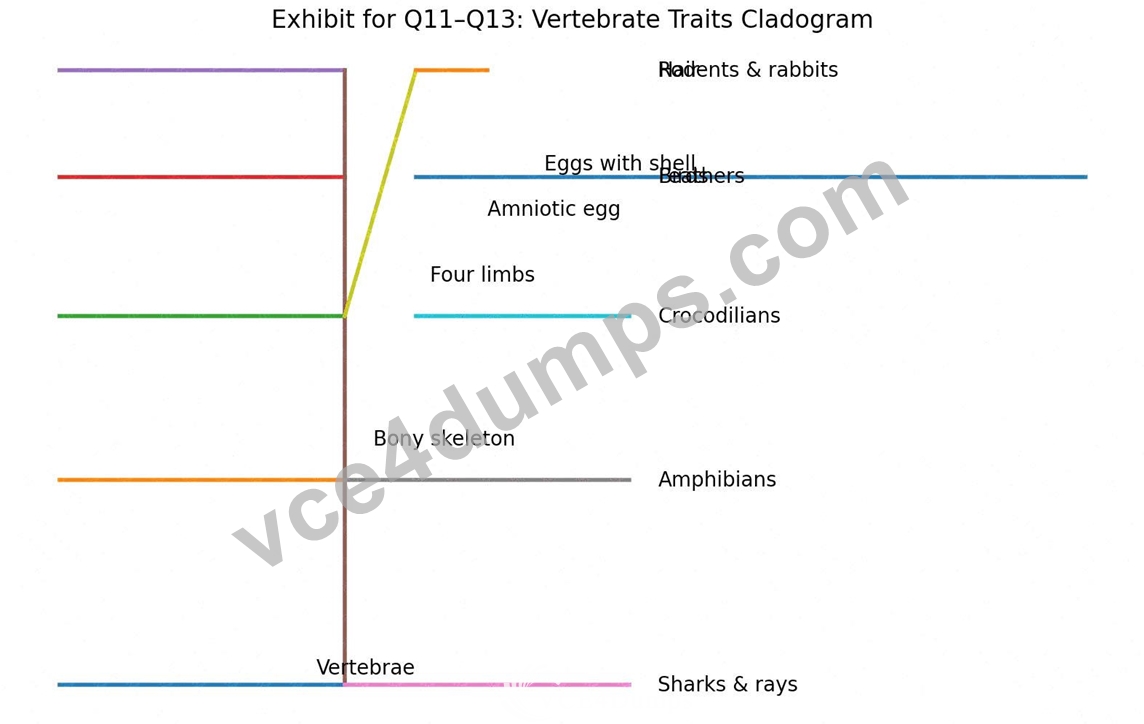
- A. Crocodilians
- B. Birds
- C. Amphibians
- D. Sharks and rays
Answer: C
NEW QUESTION # 60
A gardener performs amonohybrid crosson twoheterozygousorange-fruited tomato plants. Therecessive phenotypeis yellow fruit. What percentage of offspring will produceyellowtomatoes?
- A. 50%
- B. 100%
- C. 25%
- D. 75%
Answer: C
NEW QUESTION # 61
Chocolate is produced when yeasts, bacteria, and molds break down sugars in cacao beanswithout oxygen, yielding alcohols/acids and a small amount of ATP. Which metabolic process is occurring?
- A. Aerobic respiration
- B. Photosynthesis
- C. Cellular respiration
- D. Fermentation
Answer: D
NEW QUESTION # 62
The leopard seal is part of an Antarctic food web. It feeds oncod, which feed on small aquatic plants. Based on the energy transfer in the exhibit, how much energy does the leopard seal receive by feeding on cod?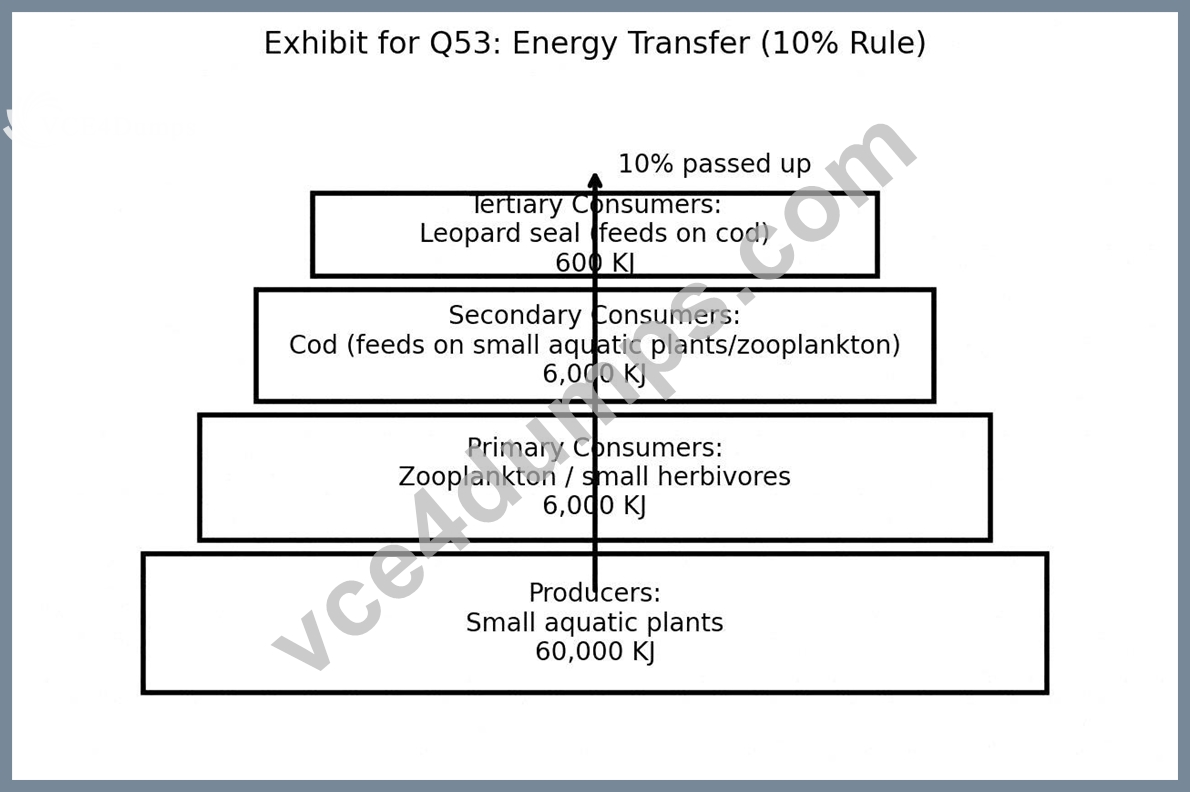
- A. 5,400 KJ
- B. 60 KJ
- C. 540 KJ
- D. 600 KJ
Answer: D
NEW QUESTION # 63
How isDNA organized during prophase, and why?
- A. Condensed, which makes it easier to move
- B. Uncondensed because it needs to be lined up at the center
- C. Organized into paired chromatids to keep it lined up at the center
- D. Uncondensed because it needs to move toward the poles
Answer: A
NEW QUESTION # 64 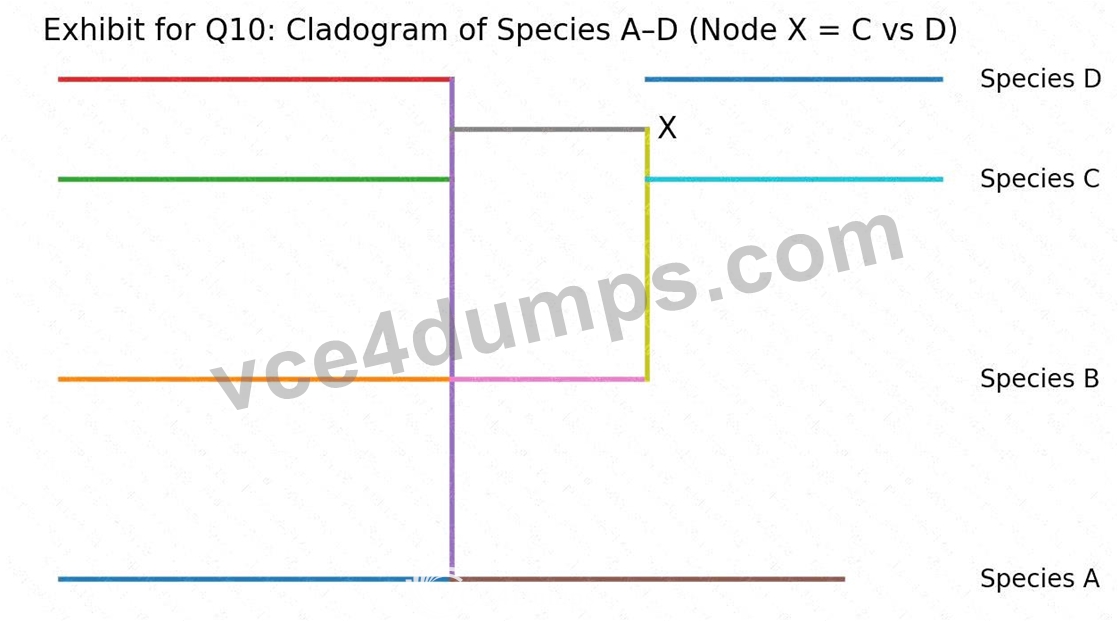
Refer to theSpecies A-D Cladogram (Node X). What doesNode Xrepresent?
- A. The point at which species C and D diverged from species B
- B. The point at which species C and D diverged
- C. The point where species B, C, and D diverged from species A
- D. The common ancestor of species A, B, C, and D
Answer: B
NEW QUESTION # 65
The nucleus contains chromosomes that are replicated and passed to the next generation. One of the two macromolecules in chromosomes is themolecule of heredity. Which molecule is the hereditary material?
- A. Carbohydrates
- B. RNA
- C. Proteins
- D. DNA
Answer: D
NEW QUESTION # 66
Which statement istrueof aprokaryoticcell?
- A. It contains a nucleus but lacks a cell wall.
- B. It is one of the smallest living cells, has a cell wall, and contains a nucleoid region.
- C. It contains a nucleus and membrane-bound organelles.
- D. It is found in plants, has chloroplasts, and its DNA is in a nucleus.
Answer: B
NEW QUESTION # 67
Mangroves shelter many species. Pelicans and herons both feed on small invertebrates and fish. What type of interaction do pelicans and herons share?
- A. Mutualism
- B. Herbivory
- C. Predation
- D. Competition
Answer: D
NEW QUESTION # 68
......
Introduction-to-Biology Premium PDF & Test Engine Files with 80 Questions & Answers: https://examtorrent.vce4dumps.com/Introduction-to-Biology-latest-dumps.html