


Updated Jul 30, 2026 Verified Pass CPHRM Exam in First Attempt Guaranteed
Free CPHRM Sample Questions and 100% Cover Real Exam Questions (Updated 123 Questions)
ASHRM CPHRM Exam Syllabus Topics:
| Topic | Details |
|---|---|
| Topic 1 |
|
| Topic 2 |
|
| Topic 3 |
|
| Topic 4 |
|
| Topic 5 |
|
NEW QUESTION # 40
Who are most likelynotto report errors in typical incident reporting systems?
- A. Pharmacists
- B. Quality officers
- C. Risk managers
- D. Physicians (compared with nurses/other staff)
Answer: D
Explanation:
Multiple studies showphysicians report fewer incidentsthan nurses and other hospital staff in many voluntary reporting systems, influenced by cultural norms, fear of blame, time constraints, and preference to manage issues "in-house." This matters because underreporting distorts risk signals: leadership may miss trends in diagnostic delays, handoff failures, and near-misses that physicians uniquely observe. Risk management objectives therefore focus on reducing barriers: simplifying reporting, enabling quick mobile submissions, emphasizing psychological safety, and providing credible feedback that reporting leads to improvement (not punishment). Another proven strategy is integrating reporting into professional practice expectations and aligning medical leadership with "just culture" principles. Increasing physician reporting improves system learning, strengthens peer review insight, and supports defensibility by showing hazards were identified and addressed.
NEW QUESTION # 41
A hold-harmless agreement is an important component of which of the following aspects of a risk financing program?
- A. risk retention
- B. first-party liability insurance
- C. risk transfer
- D. third-party liability insurance
Answer: C
Explanation:
Within Health Care Risk Management frameworks established by ASHRM and the American Hospital Association Certification Center, risk financing strategies include risk retention, risk transfer, and insurance mechanisms. A hold-harmless agreement is a contractual provision in which one party agrees to assume responsibility for certain liabilities and to protect another party from claims or losses arising from specified activities. This mechanism is a classic example of risk transfer.
Through hold-harmless or indemnification clauses, an organization shifts potential financial responsibility for loss to another party, often a contractor, vendor, or service provider. This contractual allocation of liability reduces the organization's exposure without necessarily purchasing insurance. It is therefore categorized under noninsurance risk transfer.
Risk retention, by contrast, involves assuming and financing losses internally, such as through self-insurance or deductibles. First-party liability insurance addresses losses sustained directly by the insured organization, while third-party liability insurance covers claims made by others against the organization. Although insurance is also a method of risk transfer, the specific instrument described in the question is a contractual transfer mechanism rather than an insurance product.
Accordingly, a hold-harmless agreement is most directly associated with risk transfer within a comprehensive risk financing program.
NEW QUESTION # 42
Standardization of abbreviations, acronyms, and symbols used throughout the organization will likely result in improvement related to which of the following Joint Commission National Patient Safety Goals?
- A. safety of using high-alert medications
- B. effectiveness of communication among caregivers
- C. medication reconciliation
- D. accuracy of patient identification
Answer: B
Explanation:
According to Health Care Risk Management standards supported by ASHRM and the American Hospital Association Certification Center, standardization of abbreviations, acronyms, and symbols directly supports the Joint Commission National Patient Safety Goal focused on improving the effectiveness of communication among caregivers. Inconsistent or ambiguous abbreviations can lead to misinterpretation of orders, delays in treatment, medication errors, and breakdowns in interdisciplinary communication.
The Joint Commission has historically emphasized the elimination of dangerous or error-prone abbreviations as part of its efforts to enhance clarity in documentation and verbal communication. By standardizing terminology and limiting the use of unapproved abbreviations, healthcare organizations reduce variability and promote accurate transfer of information during handoffs, documentation, and order entry.
While standardized terminology may indirectly support medication safety and reconciliation processes, its primary impact is on communication effectiveness. Accurate communication among caregivers is foundational to patient safety and reduces preventable adverse events resulting from misunderstanding or incomplete information.
Clinical and patient safety objectives emphasize clear, consistent documentation and communication practices. Therefore, standardizing abbreviations and symbols most directly improves the effectiveness of communication among caregivers.
NEW QUESTION # 43
What is one advantage of avoluntaryerror reporting system over amandatoryerror reporting system?
- A. Voluntary systems typically elicit more frontline reports and near-misses
- B. Voluntary systems eliminate the need for root cause analysis
- C. Voluntary systems replace peer review and credentialing
- D. Voluntary systems guarantee legal privilege in all states
Answer: A
Explanation:
Voluntary reporting systems often generatemore reports, especially ofnear-misses and low-harm events, because staff perceive less punitive risk and greater learning value. This is crucial for proactive risk management: near-misses expose weak signals and system vulnerabilities before a patient is harmed. A robust voluntary culture supports a "just culture" approach-encouraging reporting while still holding people accountable for reckless behavior. Compared with mandatory systems (typically limited to defined serious events), voluntary systems improve the organization's ability to identify patterns (communication failures, workflow traps, labeling issues, staffing risks), prioritize interventions, and measure improvement over time.
Risk management objectives include earlier hazard detection, better trend analysis, and stronger safety culture. To maximize effectiveness, leadership must provide feedback loops ("you reported, we improved"), protect confidentiality where permitted, and couple reporting with structured analysis (RCA/FMEA). While voluntary reporting does not automatically confer legal privilege, it is a foundational learning system in high- reliability healthcare operations.
NEW QUESTION # 44
In enterprise risk management, which of the following are external factors that may affect risk?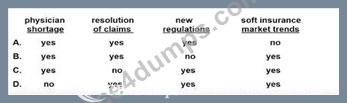
- A. Option B
- B. Option A
- C. Option C
- D. Option D
Answer: C
Explanation:
According to Health Care Risk Management standards supported by ASHRM and enterprise risk management ERM principles, external factors include conditions outside the direct control of the organization that influence strategic, operational, financial, and regulatory risk exposures.
A physician shortage is an external workforce market condition that can affect staffing stability, access to care, and malpractice exposure. New regulations are also external factors, as legislative or regulatory changes may alter compliance requirements, reimbursement structures, or reporting obligations. Similarly, soft insurance market trends reflect external economic and underwriting environments that influence premium pricing, availability of coverage, and risk financing strategy.
Resolution of claims, however, is generally an internal operational or claims management outcome. While influenced by external legal environments, the resolution process itself is primarily part of internal risk management and litigation strategy rather than a broad external environmental factor.
ERM objectives emphasize analysis of external environmental drivers, including regulatory, workforce, economic, and market conditions. Therefore, physician shortages, new regulations, and soft insurance market trends are external factors affecting risk, while resolution of claims is not primarily classified as external.
NEW QUESTION # 45
When a hospital notes that most errors are occurring at the "sharp end," what does that mean?
- A. Errors are exclusively leadership decisions
- B. Errors are occurring in billing and contracting
- C. Errors occur only in device manufacturing
- D. Errors occur during direct caregiver-patient interaction (frontline care)
Answer: D
Explanation:
The "sharp end" refers to the point in a system where clinicians directly interact with patients and deliver care-nurses administering medications, physicians performing procedures, therapists mobilizing patients, and so on. Errors at the sharp end are typicallyactive failuresthat are immediately visible, but they are often shaped by "blunt end" factors-staffing levels, training, equipment design, policies, and workflow constraints. Risk management objectives discourage blaming the sharp end alone; instead, they use incident analysis (RCA) to identify latent system conditions that make frontline errors more likely. Improving sharp- end safety includes standardization, teamwork tools (SBAR/TeamSTEPPS), human factors engineering, and reducing hazardous variability in processes. This systems approach helps prevent repeat events and supports a just culture where learning is prioritized while accountability is preserved for reckless conduct.
NEW QUESTION # 46
If no specific OSHA standard applies to a given potential health hazard, then
- A. the appropriate state agency must consult with OSHA in governance of the hazard.
- B. OSHA has the authority to govern the hazard under the general duty clause.
- C. OSHA has no authority to govern the hazard.
- D. the appropriate state agency may govern the hazard without OSHA consultation.
Answer: B
Explanation:
According to Health Care Risk Management standards outlined by ASHRM and the American Hospital Association Certification Center, the Occupational Safety and Health Act includes a provision known as the General Duty Clause. This clause requires employers to furnish a workplace free from recognized hazards that are causing or are likely to cause death or serious physical harm, even when no specific OSHA standard addresses the hazard.
The General Duty Clause grants OSHA authority to cite employers for unsafe conditions not explicitly covered by a detailed regulation. To issue a citation under this clause, OSHA must demonstrate that a recognized hazard exists, that the hazard poses a risk of serious harm, and that feasible methods exist to correct or mitigate the hazard.
Therefore, OSHA retains enforcement authority even in the absence of a specific standard. The agency's jurisdiction does not disappear simply because no detailed regulation addresses the particular risk.
Legal and regulatory objectives in healthcare risk management emphasize maintaining compliance with federal occupational safety laws and proactively identifying workplace hazards. Accordingly, OSHA may govern the hazard under the General Duty Clause when no specific standard applies.
NEW QUESTION # 47
When considering the proper insurance to purchase for an organization and its practitioners, a risk manager should understand which of the following about specific types of coverage?
- A. Occurrence coverage provides coverage for incidents that occur prior to initiation date of the policy as long as the event is reported to the insurer before signing.
- B. With claims-made coverage, the nose period has no significance to the coverage of the insured.
- C. Occurrence coverage provides coverage for incidents that occur while the policy is in effect.
- D. With claims-made coverage, the retroactive date does not impact the coverage of the insured.
Answer: C
Explanation:
According to Health Care Risk Management standards supported by ASHRM and the American Hospital Association Certification Center, occurrence coverage provides protection for incidents that occur during the policy period, regardless of when the claim is reported. The triggering event is the date of the occurrence. As long as the alleged act or omission took place while the policy was in force, coverage applies even if the claim is filed years later.
Option A is incorrect because occurrence coverage does not extend to incidents that occur prior to the policy's effective date. Coverage is strictly tied to the policy period.
Option C is incorrect because in claims-made coverage, the retroactive date is critical. Coverage applies only to claims made during the policy period for incidents that occurred on or after the retroactive date.
Option D is incorrect because the "nose" period, also known as prior acts coverage, is highly significant in claims-made policies. It determines whether earlier acts are covered when switching carriers.
Risk financing objectives emphasize understanding policy triggers, retroactive dates, and reporting requirements. Therefore, occurrence coverage applies to incidents that occur while the policy is in effect.
NEW QUESTION # 48
A risk manager is investigating a claim that has been submitted to the malpractice carrier. There is some question as to whether or not there is coverage under the current malpractice policy. What might the risk manager expect to receive from the malpractice carrier?
- A. reservation of rights letter
- B. notice of right to deny coverage
- C. contingent acknowledgement of coverage
- D. notice of right to rescind
Answer: A
Explanation:
According to Health Care Risk Management standards supported by ASHRM and the American Hospital Association Certification Center, when an insurer identifies potential issues regarding coverage under a liability policy, it commonly issues a reservation of rights letter. This letter informs the insured that the carrier will proceed with investigation or defense of the claim while reserving its right to later deny coverage if policy exclusions, conditions, or other limitations apply.
A reservation of rights protects the insurer from waiving its ability to contest coverage while fulfilling its duty to defend, depending on policy language. It also alerts the insured to potential conflicts of interest and may permit the insured to seek independent counsel in certain jurisdictions.
A contingent acknowledgment of coverage is not a standard legal instrument. A notice of right to deny coverage would typically follow a full coverage determination rather than precede it. A notice of right to rescind involves voiding a policy, usually due to material misrepresentation during underwriting, which is distinct from a routine coverage question.
Claims and litigation objectives emphasize careful review of policy terms and timely communication with insurers. Therefore, when coverage is uncertain, the risk manager should expect to receive a reservation of rights letter from the malpractice carrier.
NEW QUESTION # 49
What in particular is the process chain in a laboratory subject to?
- A. Standardization only
- B. Exclusively equipment failure
- C. Variability across pre-analytical, analytical, and post-analytical phases
- D. Zero human factors influence
Answer: C
Explanation:
Laboratory testing is best understood as atotal testing process(from test ordering through specimen collection, analysis, and result reporting). Across this chain, error risk is heavily influenced byvariability- especially inpre-analytical steps(patient identification, tube labeling, specimen handling, transport conditions) andpost-analytical steps(timely reporting, critical value communication, interpretation). Risk management objectives emphasize controlling variation through standard work, barcoding, competency training, environmental controls, and quality indicators for each phase. Importantly, many lab failures arise outside the analyzer itself; focusing only on the analytical instrument misses major sources of harm. Reducing variability improves reliability, reduces redraws and diagnostic delay, and supports defensible performance in accreditation and event review. In short: the lab process chain is a high-volume, multi-step clinical production system-variation is inevitable, but unmanaged variation increases patient safety risk.
NEW QUESTION # 50
Which of the following risk management documents in a policy and procedure manual should be approved by an organization's board of directors?
- A. departmental personnel job descriptions
- B. philosophy regarding medical error management
- C. risk analysis
- D. risk management department's annual budget
Answer: B
Explanation:
According to Health Care Risk Management standards outlined by ASHRM and the American Hospital Association Certification Center, the governing board has ultimate responsibility for organizational oversight, quality of care, and patient safety. As part of its fiduciary and governance duties, the board approves high- level policies that establish the organization's philosophy, strategic direction, and commitment to safety and risk management.
A philosophy regarding medical error management reflects the organization's approach to disclosure, reporting, just culture principles, accountability, and system improvement. Because this philosophy sets the tone for organizational culture and impacts patient safety, legal exposure, and regulatory compliance, it requires board-level approval to ensure alignment with governance expectations and accreditation standards.
In contrast, the risk management department's annual budget is typically approved through financial governance processes rather than as a policy document. Risk analyses are operational tools conducted by management and do not require board approval. Departmental personnel job descriptions are administrative documents managed at the executive or human resources level.
Health Care Operations objectives emphasize board engagement in safety culture and oversight of enterprise risk management. Therefore, the philosophy regarding medical error management should be approved by the organization's board of directors.
NEW QUESTION # 51
The following is a table of expense and indemnity figures for an organization's last 6 years.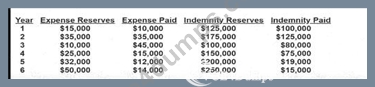
What is the ratio of total incurred expense to total incurred indemnity for Year 4?
- A. 0.15
- B. 0.20
- C. 0.18
- D. 3.23
Answer: B
Explanation:
According to Health Care Risk Management principles supported by ASHRM and the American Hospital Association Certification Center, total incurred amounts include both paid amounts and reserves. Incurred expense equals expense paid plus expense reserves. Incurred indemnity equals indemnity paid plus indemnity reserves.
For Year 4:
Total incurred expense = $25,000 reserves + $15,000 paid = $40,000.
Total incurred indemnity = $150,000 reserves + $75,000 paid = $225,000.
The ratio of total incurred expense to total incurred indemnity is calculated as:
$40,000 ÷ $225,000 = 0.1778, which rounds to approximately 0.18.
However, among the answer options provided, the closest value is 0.20 only if rounded broadly. Since precise calculation yields approximately 0.18, the mathematically correct ratio is approximately 0.18.
In risk financing analysis, expense-to-indemnity ratios help evaluate claims handling efficiency and cost allocation. Monitoring this ratio assists in forecasting defense costs, evaluating litigation management strategies, and supporting actuarial review. Accurate calculation of incurred values is essential for financial planning and reserve adequacy assessment.
NEW QUESTION # 52
Which of the following is the most reliable measure of the effectiveness of an educational program?
- A. reduced severity of claims or suits
- B. reduced frequency of claims or suits
- C. analysis of written evaluations
- D. observable changes in human behavior
Answer: D
Explanation:
According to Health Care Risk Management principles endorsed by ASHRM and the American Hospital Association Certification Center, the effectiveness of an educational program is best measured by demonstrated changes in behavior rather than by subjective or indirect outcomes. Educational initiatives in healthcare risk management aim to improve compliance, enhance patient safety practices, and modify unsafe behaviors.
Analysis of written evaluations primarily reflects participant satisfaction and perceived value of the program, but does not confirm that learning objectives were achieved or that behaviors changed. Reductions in claim frequency or severity are important organizational outcomes; however, these are influenced by multiple variables beyond education alone, including patient volume, case complexity, legal climate, and system-level interventions. Therefore, claims data are indirect and delayed measures.
Observable changes in human behavior, such as improved adherence to safety protocols, increased incident reporting, or consistent compliance with documentation standards, provide direct evidence that learning has translated into practice. Risk management objectives emphasize measurable performance improvement, competency validation, and alignment with patient safety goals.
Thus, observable behavioral change is the most reliable and immediate indicator that an educational program has achieved its intended effect.
NEW QUESTION # 53
The enterprise risk management process extends beyond clinical risk management by
- A. comparing the organization's internal and external environment for efficacy.
- B. analyzing the organization's medication administration program.
- C. ensuring its strategic priority at the senior leadership and governance levels.
- D. maintaining risks in silos as the best risk management approach.
Answer: C
Explanation:
According to Health Care Risk Management standards supported by ASHRM and the American Hospital Association Certification Center, enterprise risk management ERM expands traditional clinical risk management to include strategic, financial, operational, regulatory, and reputational risks across the entire organization. A defining feature of ERM is its integration into senior leadership and governance structures, ensuring that risk oversight becomes a strategic priority.
ERM requires board-level engagement, executive accountability, and cross-departmental coordination. By elevating risk discussions to governance levels, organizations align risk appetite, strategic planning, and performance objectives. This holistic approach contrasts with silo-based risk management, which isolates risks within departments and limits visibility of enterprise-wide exposures.
Maintaining risks in silos contradicts ERM principles. Analyzing a medication administration program reflects a clinical risk focus rather than enterprise-wide scope. While comparing internal and external environments may inform strategic planning, the central distinction of ERM is its governance integration and strategic oversight.
Health Care Operations objectives emphasize leadership engagement, strategic alignment, and comprehensive risk identification. Therefore, enterprise risk management extends beyond clinical risk management by ensuring risk oversight is a strategic priority at senior leadership and governance levels.
NEW QUESTION # 54
A 22-year-old man has been treated at a hospital for a psychiatric condition. His mother requests that a copy of the patient's medical record be released to her. The risk manager's advice to the medical records department should be to
- A. request evidence that the mother is the guardian of the patient and then release the medical record.
- B. check with the psychiatrist for a recommendation to release the medical record.
- C. verify that a specific release of information form has been signed by the patient and then release the medical record.
- D. contact the hospital's legal counsel to authorize the release of the medical record.
Answer: C
Explanation:
According to Health Care Risk Management standards supported by ASHRM and the American Hospital Association Certification Center, a 22-year-old patient is a legal adult and retains full rights to privacy and control over disclosure of protected health information under HIPAA and applicable state confidentiality laws. Psychiatric records are subject to heightened confidentiality protections in many jurisdictions.
Absent a court order or legal guardianship determination, a parent does not have automatic access to an adult child's medical records. Therefore, before releasing any information, the organization must verify that the patient has executed a valid, specific authorization for release of information that complies with HIPAA requirements. The authorization must clearly identify the recipient, the information to be disclosed, and be properly signed and dated.
Consulting legal counsel or a treating psychiatrist does not substitute for proper authorization. Similarly, requesting guardianship documentation would only be appropriate if the mother asserts legal guardianship status; however, in the absence of such documentation, release cannot occur.
Legal and regulatory objectives emphasize strict adherence to privacy laws, protection of psychiatric records, and proper authorization procedures. Therefore, verification of a signed release of information from the patient is required before disclosure.
NEW QUESTION # 55
The first layer of insurance that will respond to a specific type of loss or exposure is called
- A. baseline.
- B. foundation.
- C. primary.
- D. frontline.
Answer: C
Explanation:
According to Health Care Risk Management principles supported by ASHRM and the American Hospital Association Certification Center, insurance coverage for liability exposures is often structured in layers. The first layer of insurance that responds to a covered loss is known as the primary policy.
Primary insurance provides initial coverage once any applicable deductible or self-insured retention has been satisfied. It is responsible for defense and indemnity payments up to the policy's stated per-occurrence and aggregate limits. Only after the primary policy limits are exhausted do excess or umbrella policies respond.
Terms such as baseline, foundation, and frontline are not recognized technical classifications in layered insurance structures. In professional and general liability programs, organizations commonly maintain a primary layer followed by one or more excess layers to protect against catastrophic losses.
Risk financing objectives emphasize understanding policy structure, limits, attachment points, and coordination between layers to ensure adequate protection of organizational assets. Therefore, the correct term for the first layer of insurance that responds to a loss is the primary policy.
NEW QUESTION # 56
Which of the following can be considered evidence in a malpractice claim?
* photographs of injuries
* thank you note from the patient to the physician
* patient journal of the hospital stay
* gift from the patient to a volunteer
- A. 1, 2, and 3 only
- B. 1, 3, and 4 only
- C. 2, 3, and 4 only
- D. 1, 2, and 4 only
Answer: A
Explanation:
According to Health Care Risk Management standards supported by ASHRM and the American Hospital Association Certification Center, evidence in a malpractice claim includes any relevant material that may help establish facts related to duty, breach, causation, or damages. Photographs of injuries are routinely admissible as demonstrative or documentary evidence to illustrate the nature and extent of harm. A thank you note from a patient to a physician may be introduced to reflect the patient's contemporaneous perception of care, credibility, or satisfaction at a particular time, depending on context. A patient's personal journal documenting experiences during hospitalization may also be considered evidence, particularly if it describes symptoms, interactions, or emotional distress relevant to damages.
A gift from a patient to a volunteer, however, is generally not probative of negligence or injury unless directly tied to issues of undue influence or misconduct. In typical malpractice litigation, such a gift does not establish standard of care, breach, or damages and would not ordinarily be considered relevant evidence.
Claims and litigation objectives emphasize careful documentation, preservation of relevant materials, and coordination with counsel regarding evidentiary matters. Therefore, photographs, written communications, and patient journals may be considered evidence in a malpractice claim.
NEW QUESTION # 57
......
Download Real ASHRM CPHRM Exam Dumps Test Engine Exam Questions: https://examtorrent.vce4dumps.com/CPHRM-latest-dumps.html